
Track Alignment
Vertical and horizontal track sections are checked for bends, separation, loose brackets and incorrect spacing. A repair may involve controlled straightening, bracket adjustment or replacement of a damaged section.
Serving Quincy, Florida
Correct jammed rollers, misaligned tracks and uneven movement before operating the door causes more damage.
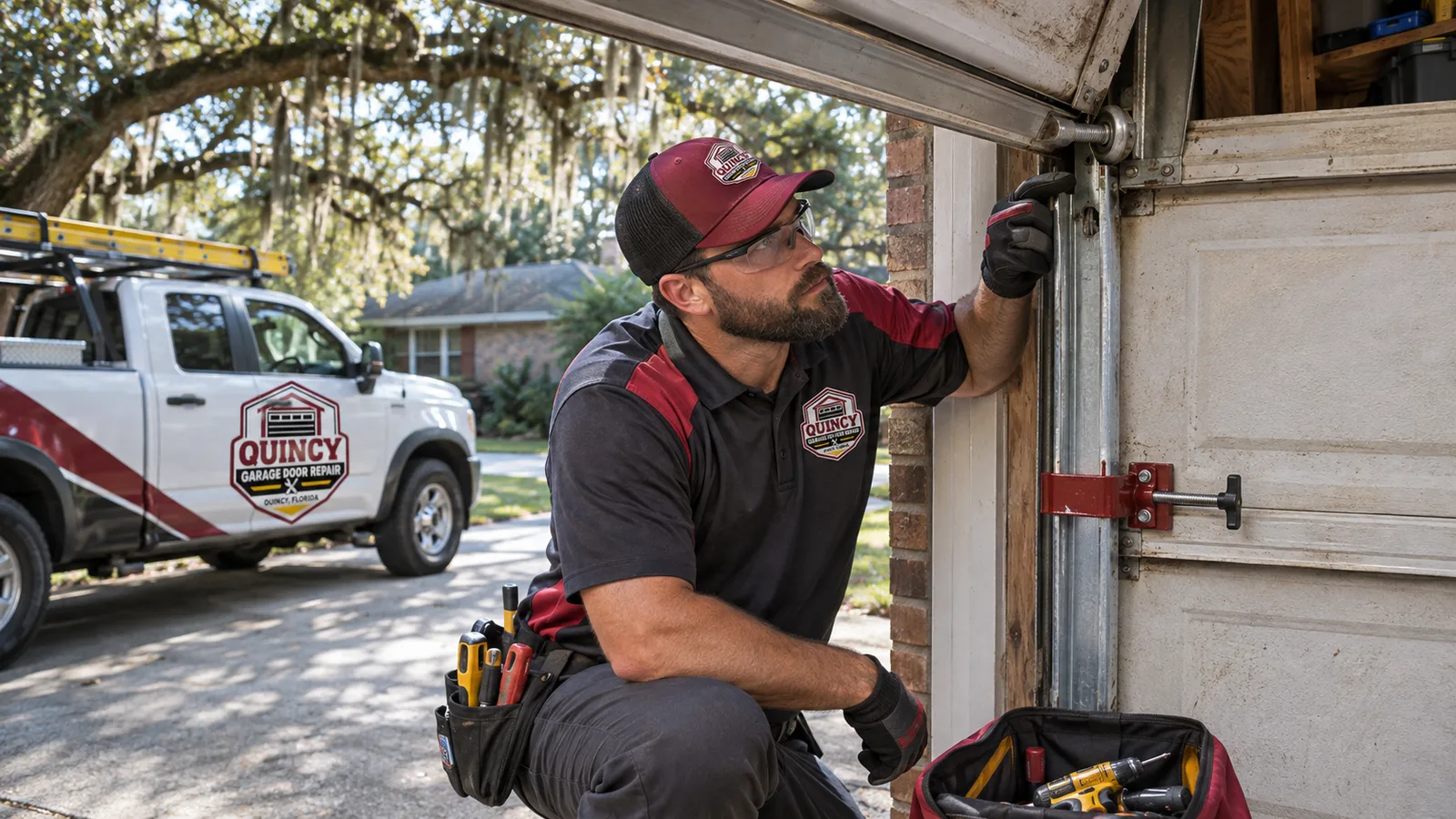
A garage door that hangs crooked, binds during travel or has a roller outside the track needs prompt attention. Garage door off track repair in Quincy, FL starts with securing the door, identifying why it shifted and checking the track, rollers, hinges, cables and mounting points before movement is restored.
Do not press the opener again or try to force the door by hand. A door can weigh hundreds of pounds, and a partially detached panel may move without warning. Continued operation can bend track sections, pull fasteners from their supports or place uneven tension on the lifting system. If a cable is loose, frayed or off its drum, keep clear of it and leave spring and cable work to a trained technician.
Quincy Garage Door Repair approaches this work as a garage door company Quincy homeowners rely on, with attention focused on the cause rather than simply pushing a roller back into place. The goal is controlled movement, correct track spacing and a complete operational check before the door returns to use.
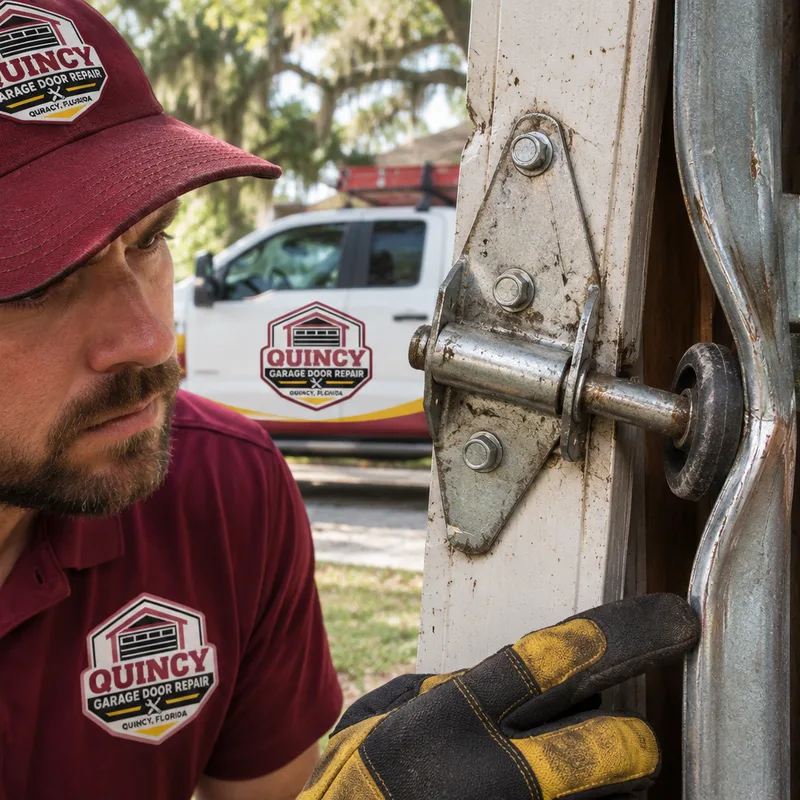
An off-track condition is sometimes obvious: a roller is visibly outside the steel guide, or one side of the door sits lower than the other. Other signs include scraping, a sudden stop, a gap between a roller and track, loose vertical track brackets, or a cable hanging beside the opening. A door that shudders or twists while moving may be starting to leave its intended path.
Florida humidity and wind-driven rain can contribute to corrosion on hardware, while accidental contact from a vehicle, lawn equipment or stored items can shift a track inward. Fasteners may loosen through repeated vibration. Worn rollers can tilt in the track, and an obstruction near the floor can make one side stop while the other keeps moving.
The opener is rarely strong enough to correct a mechanical bind safely. Its force can pull on the top panel or opener attachment point instead. Disconnecting an opener also does not make a crooked door safe to lift, especially when cable tension is uneven.
Vertical and horizontal track sections are checked for bends, separation, loose brackets and incorrect spacing. A repair may involve controlled straightening, bracket adjustment or replacement of a damaged section.
Rollers are examined for cracked wheels, worn bearings, bent stems and poor seating. Hinges and panel attachment points are checked because looseness can let a roller approach the track at the wrong angle.
Both lifting cables should remain correctly routed and carry balanced tension. A cable that has jumped a drum, tangled or frayed can leave one side unsupported and requires careful handling.
A panel damaged by impact can distort the roller position even when the track looks straight. The inspection checks panel edges, hinge locations and track supports for movement or deformation.
Once the door moves correctly by hand, the opener arm, travel limits and force response can be checked. Opener adjustments should not be used to overpower a binding door.
The repaired door is moved through its operating path to check roller seating, clearance, balance and contact between moving parts. Safety reversal equipment is also checked when the opener is reconnected.
Quincy Garage Door Repair begins by assessing the door's position and keeping people, vehicles and stored items away from the opening. The door must be stabilized before displaced hardware is handled.
The inspection traces the problem beyond the visible roller. Track damage, loose supports, worn rollers, cable trouble, impact damage and an obstruction are considered because each calls for a different correction.
Usable track may be reshaped and secured within proper spacing. Damaged rollers, hinges, brackets or track sections may need replacement. Cable or spring-related work is handled without releasing stored tension unpredictably.
Rollers are returned to the tracks only after the tracks and connected hardware are ready to guide them. Both sides are checked so the door does not remain twisted.
The door is tested for smooth manual travel and balanced positioning. If an opener is present, it is reconnected only after the mechanical movement is corrected, then its travel and safety response are checked.
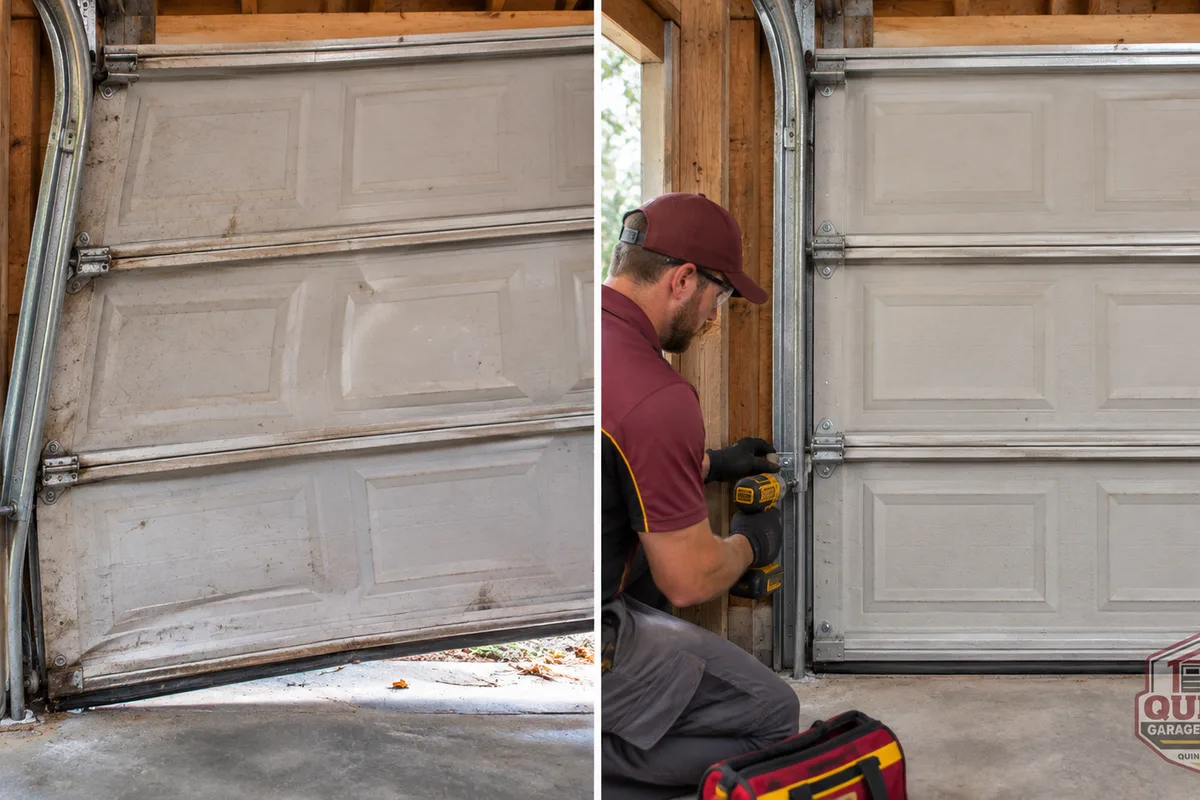
Putting the roller back without correcting the cause can lead to another jam. If the track was struck, its opening may be pinched or its mounting brackets may have shifted. If a cable lost tension, the door may remain uneven even after every roller appears seated. If a hinge or roller stem is bent, that part can continue pushing sideways against the track.
Track geometry matters as well. Vertical tracks guide the door upward, while curved sections carry the rollers into the horizontal tracks. Joints should meet cleanly, brackets must hold their settings, and rollers need enough clearance to travel without excessive side-to-side play. Lubrication can reduce friction on suitable moving parts, but it cannot repair bent steel or restore a damaged bearing.
Homes around Quincy may have attached or detached garages with different door sizes, headroom and framing conditions. Those physical conditions affect access and the parts required, so the repair should be based on the individual opening rather than a one-size procedure.
A mildly bent track may be repairable when the steel is not creased, torn or badly distorted and the mounting points remain sound. Replacement is usually the safer choice when a track section has a sharp fold, split metal, severe corrosion or damage that prevents consistent roller clearance. The connected brackets and flag supports must also be able to hold the track securely.
Panel condition affects that recommendation. If impact has pushed a panel edge or hinge mount out of shape, installing a straight track alone may not correct the roller angle. The technician must determine whether the panel and hardware can operate safely together. The same principle applies to cables: a cable that is visibly frayed or kinked should not simply be placed back on its drum.
After repair, routine observation can catch trouble early. Watch for new scraping sounds, a growing gap beside a roller, loose fasteners or one side reaching the floor before the other. Keep objects away from both vertical tracks, and never place fingers between door sections or near hinges while the door moves.
A crooked or jammed garage door can become more difficult to repair each time it is operated. Arrange an inspection before forcing the door or relying on the opener to pull it through the bind.
CALL NOW: (850) 498-4024No, stop operating the door when any roller has left the track. One displaced roller can let a panel twist, increase side pressure on nearby hinges and pull the opposite side out of alignment. Keep the Quincy garage opening clear and arrange an inspection before using the opener or lifting the door.
Yes, many off-track conditions can be corrected without replacing the complete door when the panels and main structure remain serviceable. The work may involve realigning track, replacing rollers or brackets, and correcting cable routing. Severe panel distortion or multiple damaged components can change that recommendation after inspection.
The work depends on damage, parts, access and door size. A single displaced roller with adjustable track requires different work than a bent horizontal track, damaged panel and cable problem.
An uneven door commonly points to unequal cable tension, a cable that has left its drum, a blocked track or hardware damage on one side. Do not pull the lower side into place. Lift cables and torsion components hold substantial tension, and the door should be stabilized before those parts are examined.
Not necessarily; the opener may remain usable if it was stopped before its rail, carriage or door attachment was damaged. The door's mechanical travel should be corrected first. Quincy Garage Door Repair can then check the opener connection, travel settings and safety response before powered use resumes.
Leave the door in its current position, keep everyone away and avoid touching loose cables, springs or brackets. Do not park or stand beneath a raised crooked door. If the opening cannot be secured without moving the door, prioritize personal safety and avoid attempting a temporary cable or track repair.
Call Quincy Garage Door Repair for a focused inspection of the rollers, tracks and cables.